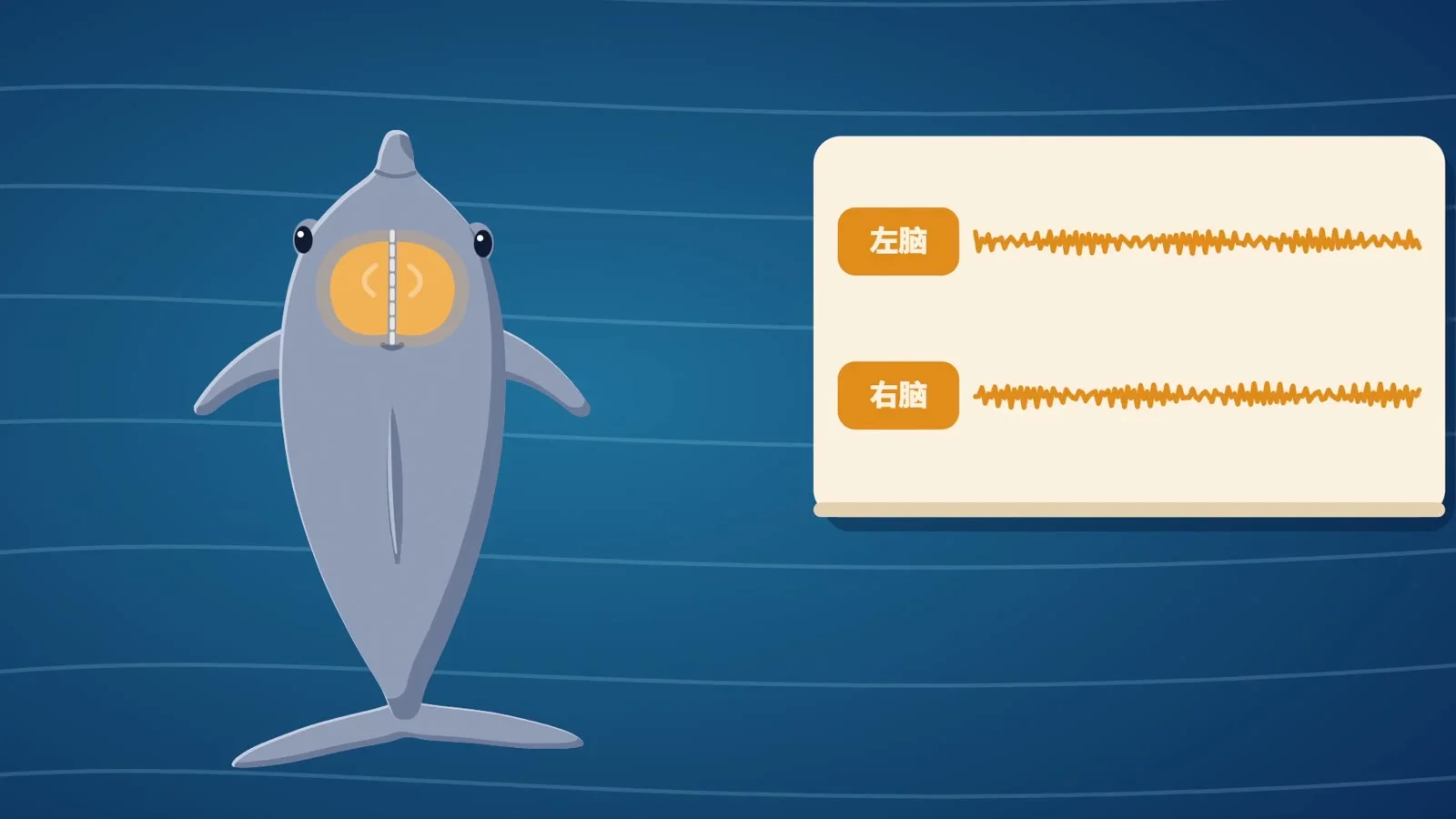
Scientists disagree on whether half-brain slow waves count as true sleep
One side argues that dolphins would rather invent half-brain sleep than give sleep up, which shows it cannot be skipped. The other points out that dolphins with slow waves on one side still avoid obstacles and swim symmetrically, so by behavioral criteria this hardly counts as sleep, and the slow waves may just be a way to save energy for half the brain.
- Evidence
- Two opposing opinion articles
- Confidence
- moderate
- Applies to
- Cetaceans (captive)
CaveatsFair to say: most researchers count it as sleep, but some question that.
In a row of sleeping ducks, the ones at the ends sleep more with one eye open, and that eye faces outward
Ducks can sleep with one eye open and half the brain. Ducks at the ends of a row do this more than those in the middle, with the open eye facing outward, and they really do spot approaching predators.
- Evidence
- Lab EEG + behavior (abstract and review account only)
- Confidence
- moderate
CaveatsPopular figures such as "ducks at the edge sleep 150% more with one eye" are not in the text we read.
Recovery sleep after deprivation is not uniform: usually only part is made up, and some animals barely make any up at certain times
After sleep deprivation, animals usually make up only about 30% of the lost time, and more through deeper sleep. Fur seals lose much of their REM sleep during months in the water and don't make it up on land; frigatebirds sleep more deeply back on land, then gradually return to normal.
- Evidence
- Review + several animal studies
- Confidence
- moderate
- Applies to
- Rats, humans, fur seals, dolphins, frigatebirds, elephants and others
- Numbers
- Usually ≤30% of lost time is made up (Siegel 2009)
CaveatsRecovery has two dimensions, duration and intensity, so looking at duration alone underestimates it (Cirelli 2008). The two camps read "animals that don't recover sleep" in opposite ways.
At sea, northern elephant seals sleep only about 2 hours a day, spiraling down hundreds of meters as they sleep
Northern elephant seals forage at sea for 7 months. To avoid orcas and sharks they sleep only once deep down: first deep sleep while holding their posture, then, in REM sleep, the body goes limp, flips over and spirals downward. Each sleep lasts only a little over ten minutes, averaging about 2 hours a day; back on shore they sleep more than 10 hours a day.
- Evidence
- Field + lab EEG (13 juvenile seals) + algorithmic estimate (334 adult females)
- Confidence
- high
- Applies to
- Northern elephant seals (EEG in juvenile females; population estimate in adult females)
- Numbers
- 10.8±3.0 h/day on land, 1.7±0.7 h/day at sea; adult females on long trips estimated at 2.2±1.6 h/day; spirals at 82-377 m depth; each sleep dive <20 min
CaveatsThe figure for 334 seals is inferred from dive profiles (93% accuracy), not from EEG on each animal. No half-brain sleep was found. It does not mean seals need only 2 hours of sleep: they sleep a lot on shore.
Two wild African elephants "slept" only about 2 hours a day on average, mostly standing, and sometimes went two days without sleep
Two wild female elephants had activity recorders fitted in their trunks, with a still trunk counted as sleep. They averaged about 2 hours a day, mainly from 2 to 6 a.m., lay down to sleep only about every 3-4 days, and several times went nearly 46 hours without sleep, walking about 30 km overnight, with no recovery sleep afterward.
- Evidence
- Field activity recording (n=2, 35 days), a proxy measure
- Confidence
- low
- Applies to
- Two wild African elephant matriarchs, Botswana
- Numbers
- Mean 2.0±1.2 h/day; recumbent sleep on only 10 of 35 days; 5 periods of about 45-48 h without sleep
CaveatsOnly 2 animals, with a still trunk standing in for sleep (the authors themselves say it may overestimate), not EEG; "no recovery sleep" rests on these few instances. Captive elephants sleep 3-7 hours.
- supportsGravett N et al. 2017Inactivity/sleep in two wild free-roaming African elephant matriarchs - Does large body size make elephants the shortest mammalian sleepers?paper · abstractSource ↗
Daily sleep in mammals varies nearly 10-fold: from about 2 hours to about 20
Elephants and giraffes sleep 2-4 hours a day, while big brown bats and armadillos can reach about 20. Even close relatives differ a lot (armadillos about 20 hours, sloths about 10).
- Evidence
- Comparative data compiled in reviews (mostly captive, methods vary)
- Confidence
- moderate
- Applies to
- Mammals (about 60-70 species studied)
- Numbers
- Big brown bats about 20 h/day; armadillos about 20 h; elephants and giraffes 3-4 h (captive) / about 2 h (wild elephants, n=2)
CaveatsMany figures come from captive studies decades old; lab and field, EEG and behavioral measures can't be compared directly (the Figure 4 caption in Kendall-Bar 2023 warns of this too). Claims such as "giraffes sleep only 30 minutes" are not in our sources.
How long an animal sleeps seems set more by how it lives: the more exposed its sleeping place and the more herbivorous it is, the less it sleeps
Cross-species comparisons find that animals with more exposed sleeping sites and lower places in the food chain (more herbivorous, needing more time to eat) sleep less; body mass and metabolic rate explain little. Bats may sleep 20 hours simply because, outside a few hours at dusk, going out is dangerous and there are no insects to catch.
- Evidence
- Cross-species correlation analysis + theoretical explanation
- Confidence
- moderate
- Applies to
- Terrestrial mammals
CaveatsCorrelation is not causation; based on terrestrial mammals only; studies contradict each other on body mass and brain size. The bat explanation is Siegel's inference.
Evolution can compress sleep a great deal, but it has not been seen reaching zero
Blind cavefish sleep up to 80% less than their river relatives; white-crowned sparrows sleep over 60% less for weeks during migration; male pectoral sandpipers in the Arctic sleep far less during a 3-week mating season, and those sleeping least leave the most offspring. But all of them still sleep, and extreme reductions often last only for a period.
- Evidence
- Lab behavior studies (cavefish) + field EEG (sandpipers, abstract only) + cited in a review (sparrows)
- Confidence
- moderate
- Applies to
- Mexican tetra cave populations; white-crowned sparrows; pectoral sandpipers
- Numbers
- Cavefish sleep up to about 80% less; sparrows >60% less
CaveatsThe sparrow figure is cited secondhand.